National Association for the Practice of Anthropology

NAPA Notes September 2026

Issue Contents
- President’s Letter
- Senior Editor’s Note
- Suzette Chang: Becoming – NAPA Presidency & Service
- Cathleen Crain: How do we Improve the Value of the AAA Annual Meeting for PPAs?
- Allied Organizations: ACRN Updates
- Organizational Relations Committee (ORC) Reflections
- Call for Volunteers – Social Media Mavens
- General Call for Volunteers and Publications
President’s letter
Dear NAPA Members,
This month, I traveled to Capitol Hill again to advocate for historic preservation and scientific funding within Congressional offices from Massachusetts and Delaware. Federal scientific agencies are experiencing steep cuts in their FY2027 budgets and among them are public foundations and services that support anthropological and archaeological research. More alarming, federal preservation law and regulatory processes are under attack. For over 60 years, Section 106 of the National Historic Preservation Act has provided solid guardrails that protect historically significant buildings, places, and landscapes across the country. I was glad to make the case for more federal funding and more effective federal protections for research, communities, and historic resources we as practicing anthropologists hold dear. This is work I hope to continue as I transition to Past President of NAPA at the upcoming AAA Annual Meeting.
As we prepare for St. Louis, I want to invite NAPA members to join us for a number of NAPA-sponsored sections, workshops, and events. On the Verge runs November 18-22, 2026, and practicing anthropology will be a big part of the program. NAPA kicks off the conference with workshops on Wednesday, November 18 including:
- NAPA Professional Development Workshop: Fundamentals of Effective Storytelling for Anthropologists (9:00 AM–12:00 PM)
- Put Down that CV and Craft Resumes that Resonate in the Age of AI, a NAPA/ACRN workshop (12:45–2:15 PM)
Check Out
This Offering
Inclusive Culture Strategies (ICS) Micro-Certificate Program for Anthropologists at AAA
(8:30 AM–5 PM)
Be on the lookout as NAPA posts more information about sponsored sessions and collaborations. Join us for two special events during the week:
NAPA Annual Business Meeting and Receptions Co-Hosted with the Society for Applied Anthropology, Thursday, November 19 from 8:00 PM-10:00 PM. We will transition to new leadership with President-Elect Suzette Chang stepping up and we will celebrate our volunteers, student essay contest winners, and partners with an annual awards presentation.
Then, on Friday, November 20 from 11:00 AM–4:00 PM, join us for the NAPA Careers Expo. Meet and talk with a host of Career Guides, who will be ready to take questions and connect on the many career pathways that practicing anthropology can take you. Students, early career professionals, and mid-career pivoters are welcome.
One more invitation to share. The Annals of Anthropological Practice, NAPA’s journal of 40+ years, will be sunsetting in 2027 as our section shifts to the new Anthropological Praxis journal anticipated for 2028. The editorial team, including Editor Jonathan Maupin, is welcoming submissions for the remaining issues. If you have case studies, research, or reflections from your work in business, government, nonprofit, or community settings, I encourage you to share them with colleagues and the wider practicing field. Log into AnthroSource and navigate to our AAP page with Wiley Publishing to learn more about submitting a piece to the Annals.
This is my final letter to you as NAPA president and I want to thank you for the honor of serving this community. I am grateful for the welcome and the support that NAPA and its many talented practitioners have shown me over the last two years. Thank you for trusting me with this role. I hope to see many of you in St. Louis and in the future as I continue to support NAPA.
With best wishes,
Suanna Selby Crowley
President
link back to table of contents
Contributions
Senior Editor’s Note
Author: Joshua Liggett, MS, LSSBB, CPHQ
NAPA Communications Committee Co-Chair
Dear readers,
We have a more condensed issue this time, but packed with incredible perspectives, useful information, a call to action, and an ask to participate in the betterment of our association! Please join our efforts to transform the field of anthropology through our assessment of the AAA Annual Meeting’s value for PPAs, in our committee work, and engaged citizenship!
We are actively recruiting for Member Engagement, Professional Development (Professional Standards, Workshops, etc.), Organizational Relations (Careers Expo, sNAPAshots), and Communications (Website, NAPA Notes, Social Media, etc.)! If you would like to join us in this work, let us know through our general volunteer application and we will get you connected with your preferred committees. 🙂
Happy Reading!
link back to table of contents
Becoming – NAPA Presidency & Service
Author: Suzette V. Chang
NAPA President Elect
One of my favorite reads is Mrs. Michelle Obama’s book, Becoming 1. Her stories are powerful and layered with perspective, nuanced understanding of specific chapters within her life; I hear her voice. As I read this book, it gave me an opportunity for reflection and introspection, two forms of metacognition that I value and practice within my personal and professional life. This practice became more poignant when I accepted the role as President-Elect. And now I am preparing to become and serve as the next National Association for the Practice of Anthropology (NAPA) President.
In the spirit of reflection and introspection, I understand that NAPA stands at a critical juncture. Dr. Suanna Crowley, current NAPA President, has diplomatically served to create and sustain spaces that strengthen NAPA’s purpose as the practicing arm of the American Anthropology Association (AAA). As a section of the AAA, NAPA has long been the premier professional home for applied, practicing, and professional anthropologists.
Let me be forthright by stating that I understand the rapidly changing landscape of the global workforce, advancements in digital technology, and the pressing need for anthropological insights in industry, governance, and non-profit sectors. This knowledge was clear for NAPA Presidents Dr. Crowley, and Dr. Rachel Hall-Clifford, Cathleen Crain and many others. Each leader understood and executed visionary approaches centered on strategic and collaborative investment. Each worked to align institutional resources, foster cross-sector partnerships, and invest deeply in the professional pipeline. With that said, it is my plan to further position NAPA as an indispensable catalyst for applied anthropological impact worldwide that leans into intellectual and digital capital that yields tangible value to practitioners that operate within academic and public spaces, offering high-impact outcomes for our members.
Yes, I know that I am stepping into some very big shoes and I thank the current and past NAPA Presidents for their leadership, blue-prints and service as I become the next NAPA President.
Becoming NAPA President is a commitment to amplifying the voices of practitioners on the global stage. By executing leadership that is anchored in strategic resource allocation and deep, collaborative partnerships, I plan to serve and assist NAPA into becoming a more agile, inclusive, and influential organization. Through these targeted investments, wisdom and knowledge of current and past leadership, and support from our membership, NAPA will continue to empower its members to design innovative, human-centered solutions for the world’s most complex challenges. Thank you, Mrs. Obama, for indirect leadership and guidance to becoming.
1 Obama, Michelle. Becoming. New York: Crown, 2018
link back to table of contents

How do we Improve the Value of the AAA Annual Meeting for PPAs?
Author: Cathleen Crain, MA
Co-Chair, NAPA Professional Development Committee
Every fall, thousands of us descend on the AAA Annual Meeting — a program built overwhelmingly around academic presentations and serving the incentive structures of university life. If you are a professional, practicing, or applied (PPA) anthropologist, you already know what it feels like to navigate the voluminous program from outside of those incentives: scanning session titles for the handful that speak to your interests and catching up with colleagues in hallway conversations that matter more than most of the panels. Each year, many of us are left wondering whether the discipline’s largest gathering brings sufficient value for the time and money we invest. Professional and practicing anthropologists make up the vast majority of the discipline yet remain underrepresented and underserved within AAA.
These are not new observations, and not just mine. At AAA’s 2025 Business Meeting, a member asked directly what more could be done to engage practicing anthropologists — a question association leadership answered honestly: they are still listening, still trying to understand the shape of the problem. But “still listening” only turns into change if PPAs bring back specific observations about what the meeting delivers for us and what it does not; we need to provide actionable information that AAA leadership and the program committee can act on. And, if nothing changes as a result, then we can light the torches…
NAPA has worked hard to develop, stimulate, and sponsor sessions of interest to PPAs, such as workshops, panels, and discussions. AAA has experimented with adding sessions that may interest PPAs. But the progress is extremely slow and often does not feel well informed by PPAs themselves. And, unfortunately, those in a position to develop and lead such sessions are increasingly determining that the cost of participating is not worth the benefit.
So, here is what I am asking of PPAs attending the St. Louis meeting: engage with us in some focused observations and report back. Areas to focus on are shared below; you tell us what we missed and add that to your observation and analysis. Here is a link to a simple reporting form that you can download and use to document your fieldnotes!
Please share it with other professional and practicing anthropologists. On the form, you will find instructions for returning it. We will accept responses until December 15th, 2026.
Your observations and analysis will help build a case for what a PPA-relevant annual meeting should include. Praise and criticize; be a good anthropologist and a good consumer. We will make sure that your views and ideas get back to leadership.
Five Kinds of Value Worth Watching for at the Meeting
Research on why people attend professional and academic conferences generally converges on a handful of value categories. But PPAs at an academically-dominated meeting face a distinct version of this calculus. Some of these value types are things a conference like ours can deliver easily, while others are structurally harder to find here, and that’s exactly the evidence worth documenting.
1. Learning and translation value. Did you encounter content — panels, papers, posters — that you could actually translate into your work? Not “it was interesting,” but “I could use this.” This is the category most likely to come up short for professional and practicing anthropologists because most sessions are built to satisfy publication and promotion imperatives, not necessarily valuing applied relevance. Note specifically where you find translatable content.
2. Network value — both kinds. Two distinct networks are worth observing. One is your PPA peer network, comprised of the other practicing anthropologists you already know or want to know, often built through NAPA’s Careers Expo, mentoring sessions, section meetings, and informal gatherings. The other is cross-sector network value: real conversations with academic anthropologists that could turn into collaboration, a referral, a guest lecture invitation, or simply better understanding of what PPA work actually involves. Track both. If one is plentiful and the other is scarce, that’s worth knowing.
3. Visibility and legitimacy value. Did PPA work show up in the meeting’s most visible spaces (e.g., plenaries, featured sessions, award recognitions) or only in practitioner-specific sessions that academic attendees are unlikely to wander into? A meeting can offer PPA content while still keeping professional and practicing anthropology largely invisible to the rest of the discipline.
4. Career and professional development value. Job market conversations, skills-building sessions, and career-stage-specific content are the standard professional-development payoff of any conference. Different kinds of content may be of greater value to you at different points in your career journey. Note not just whether it was present, but whether it matched where you actually are.
5. Field identity and belonging value. Sometimes the value isn’t concrete; it’s the feeling of being part of the discipline, of anthropology as your intellectual home, independent of any specific professional payoff. This is real, and it counts. But it’s worth naming separately from the other four, because a meeting can deliver a strong sense of belonging while still failing to deliver translatable content or genuine cross-sector connection. Distinguishing the two is exactly what will make the survey data useful.
Why This Matters Now
If we want the annual meeting to be more relevant, welcoming, and effective for PPAs, we need to be specific about what will make that happen. To shift the balance, we need to be clear about the costs and the specific benefits for PPAs that make it worth the cost.
Let’s all go into this year’s meeting as professional observers and analysts. Please jot down specifics (e.g., a session, a conversation, a moment of visibility or invisibility) as they happen, while they’re fresh. When you get home from the meeting, you can turn your notes into the kind of information that can actually move a program committee: not “the meeting felt academic,” but “here is exactly where translation happened, where it didn’t, and where PPA work and concerns were visible or not.”
Change is hard for everyone, and we need to be the respondents who specify the change that is needed to make the meetings valuable for PPAs! Please share your observations in the survey below!
You can also download the form and email to comms@practicinganthropology.org
link back to table of contents
Allied Organization Updates
Anthropology Career Readiness Network Update
Interns as New Partners in the Anthropology Career Resources Network (ACRN)
Author: Elizabeth K. Briody, Ph.D.
Cultural Keys Founder and Principal
Anthropology Career Readiness Network Founder
In our last NAPA Notes, we talked about the role that interns play in the work of ACRN. In this issue, we want to focus specifically on the work of two interns who have been involved in renovating portions of the ACRN website.
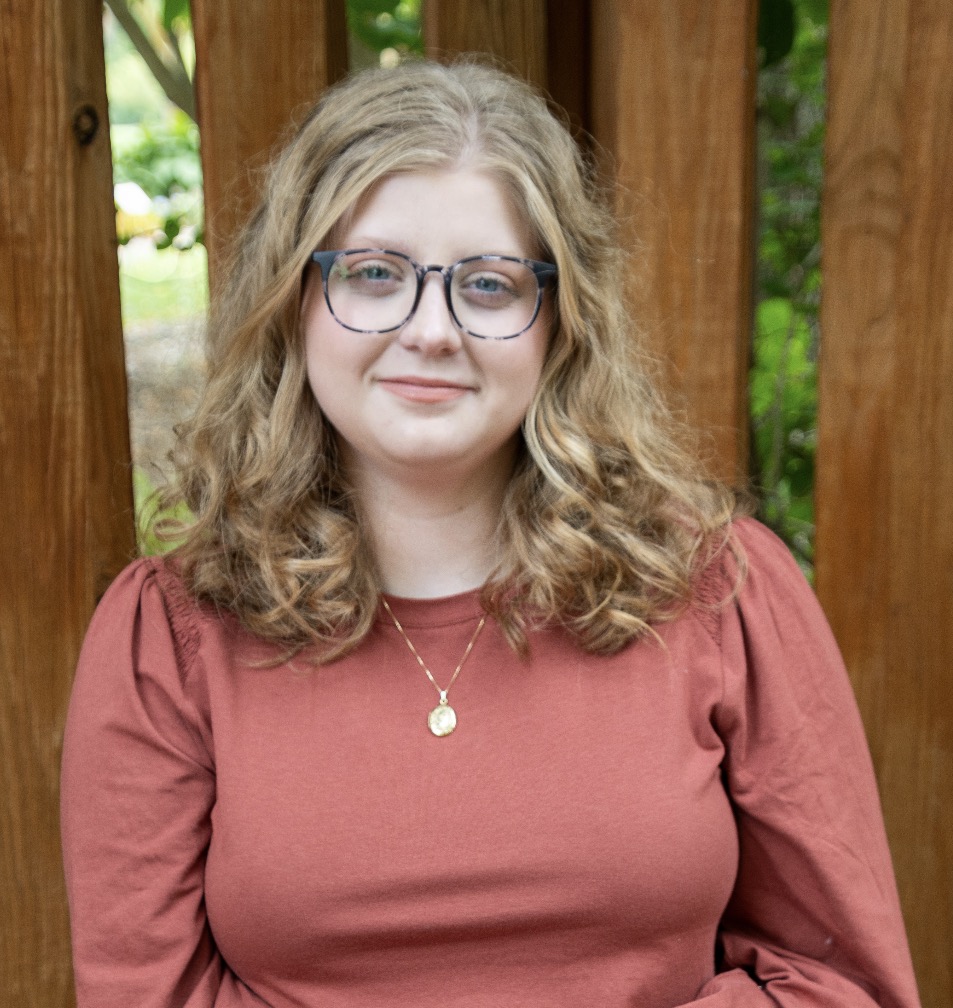
Alivia Archdale has been interning with ACRN since May 2026. She is a junior and Anthropology major at University of Wisconsin-Parkside. Alivia’s communication and organizational skills have been invaluable in her assignment to contact all speakers participating in ACRN’s Speaker’s Bureau. Her goal was to request any changes to the existing speaker profiles so that all information was current.
You might imagine that this kind of task can be exasperating—such as when emails do not get answered on the first and second “ask.” (Consider that this work was happening during the summer months!) However, Alivia’s persistence paid off. All profiles have been updated and polished, just in time for the fall semester. In addition, Alivia shepherded in some new speakers as well, so that the Speaker’s Bureau now includes 49 practitioner profiles from all four subfields.
ACRN’s Speaker’s Bureau is available to anyone free of charge. It is fully searchable by name, specialization area, and location.
The Speaker’s Bureau is primarily used by anthropology instructors who seek speakers in their courses. For example, one professor arranged for her class to conduct an informational interview with an ACRN speaker to familiarize the class with this technique. Furthermore, the Speaker’s Bureau has other applications as well including Zooming in a practitioner for
- an Anthropology Department/Program event (e.g., career panel, workshop, or webinar)
- an Anthropology Club event (e.g., Q&A on a particular career or career advising)
- an event sponsored by a for-profit or nonprofit organization.
Perhaps its most frequent usage is by students who like to search for practitioners in a domain of interest (e.g., medical anthropology) and peruse the profiles connected with that domain.
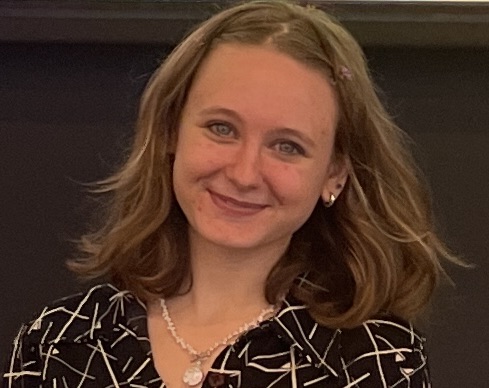
Maryn Ascher began her internship in May as well, right after she graduated with a double major in Anthropology and Forensic Science from Syracuse University. Maryn told us that she enjoyed searching the literature so that her internship entailed updating our Anthropology Resources page (located under the “For Students” page).
Anthropology Resources is a searchable database on articles, books, videos, and other media on anthropological practice. Maryn focused her attention on the last few years, identifying a number of materials to be included. For example, she pored through recent issues of the Journal of Business Anthropology to find useful articles for practitioners, students, and instructors, as well as the Annals of Anthropological Practice and other practitioner-friendly anthropology journals. She selected recent books including Profiles of Anthropological Praxis: An International Casebook (2022) which contains case examples of Praxis Award-winning projects edited by Terry Redding and Charles Cheney, as well as the 2nd ed. of Riall Nolan’s popular resource Using Anthropology in the World: A Guide to Becoming an Anthropologist Practitioner (2026).
Maryn’s reach was global as she sought to incorporate publications that reflected a nationally diverse group of anthropologists, including:
- Podjed, D. and C. Guerrón Montero, eds. (2025) Why the World Needs Anthropologists. 2nd ed., Routledge.
- Wilson, L., G. Hoffstaedter, and S. Babidge, eds. (2026). Anthropology as a Vocation: A Discipline for a Changing World. Simple Book Publishing, https://uq.pressbooks.pub/anthropology-vocation/
- Koycheva, L, A.K. Vandenbroek, and M. Artz, eds. (2026). Anthropology and AI.Routledge.
- Strang, V. (2021). What Anthropologists Do. 2nd ed., Routledge.
- Gluesing, J.C., C. Miller, and H. Wild. (2025). Innovation in the Anthropological Perspective: Insights and Consequences for the Theory, Practice, and Design of Innovating. Routledge.
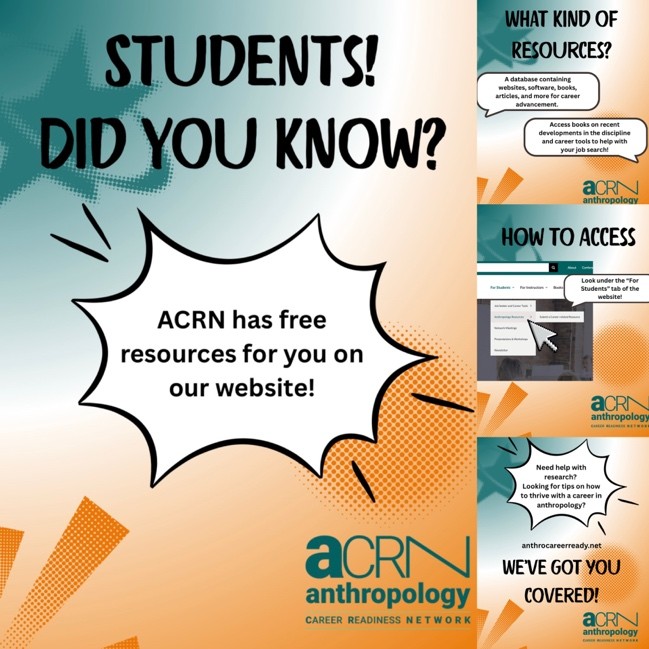
Perhaps you saw one of Maryn’s promotional campaigns for the Anthropology Resources page? Please share this information with your colleagues and students. As Maryn says, “We’ve Got You Covered!”
link back to table of contents
Committee Updates
Organizational Relations Committee (ORC) Reflections
NAPA Careers Expo
This will be our last NAPA Notes issue before the AAA Annual Meeting and we are finalizing the last few details and confirming our list of volunteers, Career Guides (CGs), and Allied Organizational Representatives (AORs).
We are so grateful to all of our colleagues who have agreed to participate and share the lessons they have learned along the way through their varied and impressive careers!
To our allied organizations, thank you for sharing this space with us and helping shape a broader vision of applied, practicing, and professional careers in Anthropology!
To the students, newly-minted anthropologists, career-changers, and mentors who join us this year: we’re excited to have meaningful conversations around our work and what a future applied, practicing, and professional career in our fields could look like for you!
See you all in St. Louis! If you aren’t able to join us this year, please stay tune as we plan for Portland in 2027 and other similar offerings!
Niel Tashima & Joshua Liggett
Co-chairs, NAPA Organizational Relations Committee
link back to table of contents
Call for Volunteers
NAPA Communications – Social Media Mavens
Want to be at the center of the NAPA action? Want to know what we’re doing first and share that with the field? Become part of NAPA’s volunteer information communication hub and promote real world job opportunities and content across NAPA’s social media! Visit our contact portal and inquire today!
link back to table of contents
General Call for Volunteers and Publications
Interested in joining our team, but not sure which committee is right for you? Checkout our general volunteer application and one of our coordinators will connect you with the ones that best align with your interests and skill sets!
If you’d like to publish something with NAPA either in NAPA Notes, AnthroNews, or on our website or social media, visit our submission page and let us know.
link back to table of contents

![[NAPA Logo] sNAPAshots: Conversations with Professional, Practicing, and Applied Anthropologists. Kamela Heyward-Rotimi, PhD Cultural Anthropologist & Executive Director Knowledge Exchange Research Group. PracticingAnthropology.org Bluesky, X, Meta, LinkedIn, and Youtube Logos](https://practicinganthropology.org/wp-content/uploads/Kamela-Heyward-Rotimi-Executive-Director-Knowledge-Exchange-Research-Group.-1-768x960.png)
![[NAPA Logo] sNAPAshots: Conversations with Professional, Practicing, and Applied Anthropologists. Sheena McKinlay, Chief Impact Officer, Miracle Messages. PracticingAnthropology.org Bluesky, X, Meta, LinkedIn, and Youtube Logos](https://practicinganthropology.org/wp-content/uploads/Sheena-McKinlay-LinkedIn-Flyer-768x753.jpg)