National Association for the Practice of Anthropology

NAPA Notes June 2026

Issue Contents
- President’s Letter
- Senior Editor’s Note
- Introducing New Voices on NAPA Communications Committee
- Anthropology in the Headlines: Measuring the Value of 45.0201
- Practicing Anthropology and June 2026: What It Means to be a Human and I have an Ask 🙂
- Cathleen Crain: Celebrate the Longest Day
- Reshama Damle: We Are the Bridgeworkers
- Allied Organizations: ACRN Updates
- Organizational Relations Committee (ORC) Reflections
- Call for Volunteers – Social Media Mavens
- General Call for Volunteers and Publications
President’s letter
Dear NAPA Members,
Spring has been a season of significant news for Anthropology. Some of it (sadly) unsurprising, all of it revealing. But as a long-standing section of the American Anthropological Association, it is important for NAPA members to take a moment to examine the headlines and assess where we find ourselves as practicing and professional anthropologists. I hope you will stop to read this issue of NAPA Notes, and get better acquainted with local-to-national discussions about our discipline of origin.
News Briefs
In terms of NAPA news, we are excited about two things in particular. First, the new season of sNAPAShots dropped in April. If you have not found a chance for a bit of productive disruption in your daily routine, I recommend checking out Season Five and getting to know your colleagues in professional, practicing, and applied spaces.
Second, NAPA is preparing for St. Louis and the Annual Meeting of the American Anthropological Association set for November 18 to 22, 2026. Accepted session and program announcements were just beginning to circulate. Be on the lookout for details about NAPA sessions, workshops, a business meeting, and a reception.
In the meantime, I will keep this short and wish you all a splendid summer of fieldwork and fun.
With best wishes,
Suanna Selby Crowley, PhD, RPA
President
link back to table of contents
Contributions
Senior Editor’s Note
Author: Joshua Liggett, MS, LSSBB, CPHQ
NAPA Communications Committee Co-Chair
Dear Readers,
We have a packed issue of NAPA Notes, that share a moment of trial for our discipline and a call to action to support the future of our discipline and humanity, as well as more of a celebration of our colleagues and interns, across identities and career stages. We will persevere through solidarity!
Additionally, we are continuing to recruit and expand our team and capacities you should see some changes on the horizon! Here is an update of our progress through our priorities for the next year, let us know if you’d like to help out!
Actively In-Progress:
- Update the NAPA website’s Mentoring/Career Section
- Career Development is our first area to rehaul
- We’ll incorporate updated Resources and other Career Development content
- Continued support of NAPA’s social media, and flagship projects (e.g., Careers Expo, sNAPAshots, Webinar/Workshop series).
Completed Projects
- Update Contact Form
Pending Projects
- Update Publications page
- Focused updates of various pages across the website
If you would like to join us in this work, let us know through our general volunteer application.
Stay strong and pardon our dust during 2026! Happy Pride y’all!
link back to table of contents
Introducing New Voices on NAPA Communications Commitee
Author: Milena Stoilova and Mandy M. Jordan
NAPA Communications Committee Members
The National Association for the Practice of Anthropology (NAPA) depends on members who step in, share their skills, and help keep the community connected. One of the ways this happens is through the Communications Committee, which supports outreach across NAPA’s website, social platforms, and public updates so that practicing anthropologists can easily find resources, opportunities, and each other.
Today, we’re excited to introduce two members who recently joined the committee and are helping strengthen these connections.
Milena Stoilova is a cultural anthropologist and researcher with experience leading anthropological studies across diverse global contexts. She specializes in qualitative UX and cultural research, driven by a passion for amplifying marginal voices. People are at the core of her work, and through her communication and stakeholder engagement, she brings attentiveness, detail, and active listening to every project. Milena’s strengths lie in her ability to see the bigger picture and provide thoughtful analysis. She is an advocate for
NAPA’s mission to create a network of professional anthropologists across employment sectors, promoting human-centered work applied to practical problems. As a relatively recent master’s graduate, she remembers the struggle to navigate the economic climate, and NAPA has helped her enormously. Through the mentor program and connecting with like-minded professionals, she feels proud to be part of NAPA. For the Communications Committee, she supports NAPA’s social media and various updates on the website and is excited to continue supporting NAPA’s mission.
Mandy M. Jordan is a cultural and applied anthropologist whose work explores institutional culture, trauma-informed language and pedagogy, and the ways educational environments shape how people learn, heal, and build resilience. She currently serves as a Research Associate at Sam Houston State University and teaches online anthropology and social science courses at several universities. Drawing on her experience listening to trauma-exposed narratives and working in higher education and community contexts, she is especially driven by finding practical ways institutional culture can evolve to better support student success and well-being. She joined NAPA about a year ago and began volunteering with the Communications Committee this past fall after
recognizing how powerful professional networks can be for practicing anthropologists. Drawn to NAPA’s mission to connect anthropologists across sectors, she is especially interested in expanding visibility and access so that more practitioners know they have a professional community behind them. Through her work with the committee, she supports website updates and outreach and hopes to help others recognize that they are part of a network of colleagues who genuinely want to see them grow and succeed.
Together, Milena and Mandy support the Communications Committee’s work to keep NAPA’s information, resources, and opportunities visible and accessible to practicing anthropologists across sectors.
link back to table of contents
Anthropology in the Headlines: Measuring the Value of 45.0201
Author: Suanna Selby Crowley, PhD, RPA
NAPA President
Every so often, a set of data points arrives in such close proximity to one another that their combined impact demands a name. Economists call it a polycrisis. Ecologists call it habitat collapse. I call it an extinction-level event.
This spring, in rapid succession, Anthropology was delivered three such data points: a Federal Reserve Bank headline that named our field the least employable major in the country for the second consecutive year; a report commissioned by two major research university chancellors that singled out Anthropology; and a survey of humanities department chairs that described increasing pessimism about sustaining their fields.
Taken individually, each is a provocation. Together, they describe a threat matrix growing faster than our field has the institutional capacity to respond to. As NAPA President, I am naming what I see and making the case that practicing anthropologists have not only a stake in what comes next, but a unique credibility to shape it.
What the Federal Reserve Isn’t Measuring
Leading the way was the Federal Reserve Bank of New York annual report on the labor market for recent college graduates. If you care for, teach, or supervise young adults in this early career phase, then you are aware that for the second consecutive year Anthropology has the highest unemployment rate of all surveyed majors – a striking 7.9% for the most recent 2024 data, nearly double the 4.2% average across all majors tracked. That figure is down from a high of 9.4% the prior year, but the overall ranking holds: first place, worst outcomes, two years running.
Whatever the rate, we know two things right away as anthropologists.
First, we recognize immediately that this statistic is problematic. Few of us, even well into our careers, ever work under the title “Anthropologist.” But that is not what this survey measures. The source data for the Federal Reserve analysis comes from the U.S. Census Bureau’s American Community Survey, which asks respondents to free-text write-in their major. No drop-down menu. No checklist of disciplines. No standardized categories presented to the respondent whatsoever. Hand-written responses may include “anthropology,” “cultural anthropology,” “archaeology,” “biological anthropology,” or any number of related combinations. These write-in responses are reviewed, autocoded, and collapsed by Census Bureau staff into a federal taxonomic system called the Classification of Instructional Programs, or CIP. Anthropology’s code is 45.0201 – the number in this article’s title – structured as follows:
45 – for the broad family of the social sciences
02 – for the narrow program group “Anthropology”
01 – for the more specific program “Anthropology, general”
In other words, Anthropology has a zip code, one address for an entire discipline. It contains no acknowledgement for the Four Fields in the United States, no recognition for the multitude of sectors where we work, no code for the economic impact of subfields like cultural resources management within Archaeology (now a billion-dollar industry), and no trackable metric for the thousands of anthropologists working in governments, hospital systems, nonprofits, and startups.
The second point is more troubling. While the Census Bureau and Federal Reserve Bank are not measuring job titles, what they do measure (self-reported major names collapsed into a single zip code) may have a more destructive downstream effect on Anthropology than any accurate measure of unemployment ever could.
Put simply, that unemployment headline is a killer. As a very blunt tool for measuring early career employment, the impact of this news is a three-alarm fire for higher education. The message “Stay away from Anthropology!” is loud and clear for parents, scholarship committees – and in the case of Archaeology – the U.S. Department of Education, which is attempting to delist archaeology as a “professional” field and therefore restricting access to federal loans for graduate study.
In my opinion, we are on the verge of an extinction-level event for Anthropology. I do not use that phrase lightly, and I want to explain what I mean.
In this case, we are in a moment of rapid and cascading closure of many higher education training centers of Anthropology. Think dominoes falling. This includes departmental consolidation and the suspension or elimination of undergraduate and graduate programs, meaning the discipline does not give rise to new generations of scholars or practitioners, or pass on its theoretical and methodological DNA.
What makes this moment precarious is not the slow attrition of any single factor that keeps a department operating. Enrollment fluctuations, faculty turnover, and lean budget cycles were survivable in the past because these tended to occur in isolation or over time when there was opportunity to adapt.
What we are witnessing in the academy is not a decline. It is the simultaneous failure of multiple sustaining conditions, compressed into a timeline too short for recovery. Enrollment cliffs, faculty attrition, political delegitimization, budget pressures, and negative headlines arriving together mean that the normal feedback loops allowing innovation or self-correction are severed. The results are disastrous for the discipline as a whole and for the reconstitution of scholarly and practical training pipelines.
Two recent reports put this moment of polycrisis in sharp relief and demand our precious attention: the Vanderbilt/Washington University Report on the State of Scholarship in the Humanities, and the American Academy of Arts and Sciences survey of humanities department chairs.
The Vanderbilt/Washington University Report
In early June, the chancellors of Vanderbilt University and Washington University in St. Louis released the Report on the State of Scholarship in the Humanities and the Humanistic Social Sciences, commissioned from a committee chaired by New York University philosopher Paul Boghossian. The report examines Philosophy, Anthropology, Sociology, History, Literary Studies, and Music Studies, making the argument that political ideology has degraded scholarly standards across these fields.
The report has drawn sharp and, in my view, well-founded criticism, including from the American Anthropological Association. Anthropology is singled out as especially problematic. The report alleges a “toxic intellectual climate” in which dissenting views are suppressed and careers are endangered. Several anthropologists cited by name in the report have stated publicly that their work was misrepresented the by report authors. I applaud AAA President Carolyn Rouse and Executive Director Ady Arguelles-Sabatier for their immediate and forceful responses to this report and I urge you to find their statements on the AAA website and social media.
The report has, in my view, created the very toxic climate it purports to diagnose, and it has done so at precisely the moment the threat matrix for Anthropology departments is most acute. In fact, this report is adding fuel to the fire set by two years of Federal Reserve Bank headlines on the labor market for Anthropology majors, as it has the potential to become “evidence” for institutions seeking to undercut non-STEM undergraduate and graduate programs.
I encourage you to read this report in full and reflect on its meaning in your experience. As practicing anthropologists, we put our Anthropology to work at the intersection of the disciplinary rigor we gained through our degree programs and the real-world accountability we deliver to clients, colleagues, and stakeholders. We make ethical, consequential, and measurable contributions every day. We should say so, loudly and with our ROI on display. The Vanderbilt report gives us an opportunity to do exactly that.
What Humanities Chairs Are Telling Us
Released in May, The Academic Humanities Today: Opportunities & Challenges – Findings from Conversations with Department Chairs deserves equal attention and offers important insights for the moment we are in. The American Academy of Arts and Sciences (AAA&S), working with research firm Ithaka S+R, surveyed thirty humanities department chairs across a range of institutions. Notably, Anthropology was not among the disciplines represented. The findings are sobering. Chairs are broadly pessimistic about their departments’ futures, citing increasing political interference, declining enrollments, and students’ skepticism about the value of humanities degrees.
To explore the impacts of this report, the AAA invited report authors Dr. Chelsea McCracken and Dr. Claire Baytas of Ithaka S+R to a June 16 webinar for association members. If you could not attend the hour-long event or have not had a chance to view the webinar recording, I encourage you to do so when it becomes available. As NAPA members, I think you will hear and feel the results of this survey very differently than many of our colleagues in academic settings. The pessimism expressed by the surveyed chairs, regarding enrollment cliffs, faculty burnout, public perceptions, and budgetary impasses, are the exact alarm bells that drive my perspective on the risk of extinction for Anthropology.
The report raises questions I suspect many of you may also be sitting with, particularly on the idea that others in higher education have not sufficiently marketed the humanities and the long-term impact of artificial intelligence on academic employment. I look forward to expanding that conversation with our membership.
Practicing Anthropology Careers Are the ROI
Taken together, these headlines and reports frame the landscape we are working in. Anthropology is under scrutiny from powerful institutional and political voices, while the structural conditions supporting humanities and social science programs erode. This is precisely why NAPA’s work, and specifically our efforts to build career infrastructure, to demonstrate the implicit and explicit value of our discipline, and to foster the next generation of practitioners, has never mattered more.
As frustrating as the reality of 45.0201 is, my recent dive down a statistical rabbit hole does bust one important myth: this survey does not measure whether someone is employed as an anthropologist. What it measures is whether a person who once wrote something related to “anthropology” on a Census form is currently employed at all. The U.S. Census Bureau and the Federal Reserve Bank of New York are not indicting the profession. They are measuring a very simplified label. The distinction matters enormously, and it is one our complex and varied community of anthropologists has not yet made loudly enough in public.
That argument was at the center of a Washington Post op-ed published on April 27 by Thurka Sangaramoorthy, chair of the Anthropology department at American University. In “This degree changed my life. And it’s essential to a changing America,” Sangaramoorthy reframes the Anthropology degree not as a liability but as preparation for exactly the kind of complex, human-centered problem-solving that no algorithm can replace. I encourage every NAPA member to read it, share it, and use it. It is the kind of public argument we need more of and the kind of public outreach that we, as practicing anthropologists, are also equipped to make.
From Alarm to Action
In my view, the argument made in the AAA&S survey by departmental chairs that they require outside expert help to market their own disciplines is the academic equivalent of Nero fiddling while Rome burns. These are precisely the department heads with access to the networks, institutions, policy centers, and funders that could make Anthropology more sustainable. The alarm has been raised. The question is who picks up the tools to make it better.
To be sure, reducing Anthropology to a return-on-investment calculation is not an adequate tool. But we do need to understand that those economic measures and arguments are compelling to both our advocates and our adversaries, and that our absence from that conversation is not neutrality. It is ceding ground. Internally, we can continue to debate the drivers and potential outcomes of this moment. Externally, in dean’s offices and board rooms, decisions are being made without us.
That realization is what drives the extinction metaphor I have borrowed from years of interdisciplinary work in the subfield of geoarchaeology. I am not predicting the end of Anthropology. I am raising a red flag about the possibility of an institutional meteor strike. It is increasingly visible on radar and measurable in the data. Will it be something we can respond to? Practicing anthropologists, because we work outside the academy and have built careers that defy our federal zip code, are among the most credible voices available to make the counter-argument. I hope we are invited into the conversation and to be part of the solution.
Resources Referenced in This Article
• NY Fed Labor Market for Recent College Graduates: https://www.newyorkfed.org/research/college-labor-market
• Vanderbilt/WashU Report on the State of Scholarship: https://www.vanderbilt.edu/principles/state-of-scholarship-report/
• American Academy of Arts and Sciences — Humanities Chair Survey: https://www.amacad.org/publication/academic-humanities-today-opportunities-challenges-findings-conversations-department-chairs/section/1
• AAA Response by Carolyn Rouse: https://americananthro.org/advocacy-statements/aaa-response-to-report-criticizing-the-humanities/
• Thurka Sangaramoorthy, Washington Post op-ed, April 27, 2026: https://www.washingtonpost.com/opinions/2026/04/27/anthropology-teaches-an-essential-skill-era-big-data/
link back to table of contents
Practicing Anthropology and June 2026: What it Means to Be a Human Being and I Have an Ask 🙂
Author: Suzette V. Chang
NAPA President Elect
In the spirit of forthrightness (I think I just made a new word), when the NAPA Communications Team asked that I contribute to this month’s NAPA Notes, I had a mental and emotional pregnant pause. I mean, think about it, this year, June is for the most part a precursor for the United States Semiquincentennial (say that several times fast!). But it signifies so many other things, too: Pride Month which honors the 1969 Stonewall Uprising in New York City and is a pivotal turning point in the modern LGBTQ+ civil rights movement; Juneteenth, June 19, 1865, marking the day when Union troops arrived in Galveston, Texas, to enforce the Emancipation Proclamation (more than two 2 years after President Lincoln issued it); World Refugee Day which honors the strength and resilience of people forced to flee their home countries due to conflict or persecution, while celebrating the contributions they bring to their new communities; World Environment Day which inspires global action and raises public awareness for the protection and preservation of our environment. I will not overlook Summer Solstice, one of my favorite days of the year since childhood because it marks the first day of summer and Father’s Day, a day that is very dear to me now, more than ever, as my father is no longer physically with me, yet I know he is with me always. Offering insight during this month and pivotal year as the US prepares to celebrate its 250th year of independence and separation from Great Britain, is a harsh and necessary reminder of our purpose as practicing anthropologists to define, advocate, bring awareness and apply what it means to be a human being.
As practicing anthropologists, we biologically compare the similarities and differences between human beings and dogs, for example, or human beings and water; the opportunities to address the overlap and separations are significant as we relish within each scientific exploration and explanation. The pause is
- Knowing that most celebrations during June speak to a group/community that is overlooked or underestimated or dehumanized, yet its members continue to show resilience, tenacity and fight for equity;
- A reason the United States became a nation is due to the treatment of human beings that lived across the pond yet the US has and continues to dehumanize its citizens and those that seek solace and refuge (am I observing hypocrisy? – you know the answer to that question);
- The month of June speaks to our inability to treat human beings as human beings, hence the need to have so many more days and months of celebration throughout the year; and
- Excluding the biological factor, anthropologists have not provided a unified definition of what it means to be a human being and shared that definition with the world.
According to my observations and research, a human being is a biological human that receives consistent quality housing, healthcare, food, clothing and education and, here is my ask: Answer the following questions and share your responses with the NAPA Communications Team on Facebook & Instagram, LinkedIn, Twitter/X, Blue Sky, or TikTok. In turn, your responses will be shared with me:
- How do you define a human being?
- What are you doing to support that definition within the context of advocacy, awareness and application?
- What can NAPA do to assist you in your commitment?

link back to table of contents
Celebrate the Longest Day
Author: Cathleen Crain, MA
LTG Managing Partner, NAPA Past President
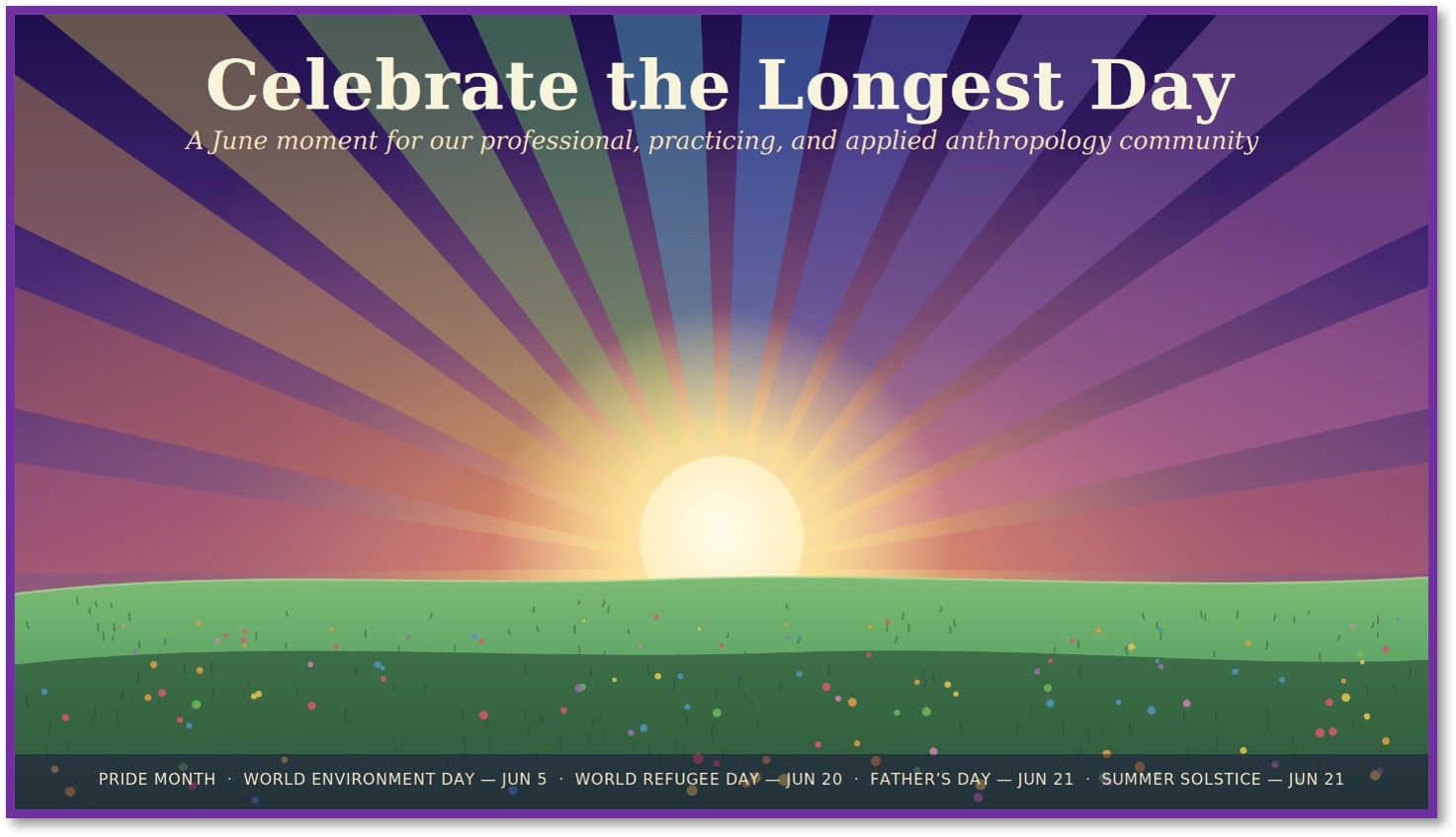
Long before I found anthropology, and then a profession, and finally a community, the longer days leading up to the summer solstice felt special and full of promise – perhaps Druidic mists in the gene pool…. It felt as though there was more time, more opportunity, more promise.
Professional, practicing, and applied (PPA) anthropologists step on cracks. We leave footprints in the dirt. We leave marks of our passing. We often go where angels fear to tread and where we may find ourselves in physical or psychic jeopardy. But we generally go with purpose, with intention, with hope. (Sometimes we just go, but that’s a different article!)
Our discipline is currently in the spotlight, accused – using flawed data collection and poor metrics – of not ensuring highly compensated careers to all of its graduates. There is an argument being made that unless you can directly track a fat paycheck to a degree, then the discipline is irrelevant. We in the PPA community, however, seeing the trails and footprints of PPA anthropologists in health, human services, industry, government, and education at all levels, importantly find ample recognition for the powerful tools and skills that we bring to complex tasks and challenges.
As we approach this solstice in a year full of uncertainty, I want to mark a number of June celebrations and some examples of anthropologists who have contributed, and are contributing, to processes and solutions that make a difference. Let’s celebrate the increasing light cast from the work of these and all PPA anthropologists. Please take a moment and follow the links to learn more about each of them.
It is Pride Month, when we celebrate an important aspect of the complexity and diversity of humans. How central and joyful it is to our worldview that who you are, who you love and who freely loves you in return are fundamental parts of being human. Let’s appreciate anthropologists who have helped to educate us and the public, demonstrating the importance of PPA work.
- Thanks to Melissa Vogel – business anthropologist, DEI and organizational culture (https://www.linkedin.com/in/melissa-vogel/)
https://www.linkedin.com/newsletters/the-anthro-minute-7281406136216424448
- Gratitude to Helen Fisher — biological anthropologist, gender and relationships expert (https://en.wikipedia.org/wiki/Helen_Fisher_(anthropologist)).
World Environment Day reminds us that part of our job as humans is to care for our environment and leave it healthy for future generations. Environmental Anthropology is a growing part of our discipline.
- Thanks to Keely Maxwell – environmental policy, natural resource management, & community resilience to disasters (https://www.linkedin.com/in/keely-maxwell-a0238782/)
- Respect to Shirley Fiske — environmental and policy anthropologist (https://en.wikipedia.org/wiki/Shirley_Fiske)
- Appreciation to Rob Winthrop — cultural anthropologist – environment, natural resources, and energy (https://www.linkedin.com/in/robert-winthrop-589890132/).
World Refugee Day marks a focus on those who become refugees, that is, according to the United Nations, persons who have “fled their country of origin and [are] unable or unwilling to return due to a well-founded fear of persecution, conflict, violence, or serious public disorder,” and also the conditions that create such movements. Generations of PPA anthropologists have been instrumental in working on issues such as responses to conditions producing refugee movements, ways to create physical and psychological safety both during and after resettlement, and the downstream development of refugee communities.
- Kudos to Peter VanArsdale — applied cultural and medical anthropologist with a sub-specialty in refugee studies (https://en.wikipedia.org/wiki/Peter_W._Van_Arsdale )
- Thanks to Olive Minor — applied anthropologist working at the intersection of global health and technology (https://www.linkedin.com/in/olive-melissa-minor/)
- Respect to Thurka Sangaramoorthy — cultural and medical anthropologist and global health expert (https://www.linkedin.com/in/tsangara/)
- Appreciation to Adam Koons — applied and economic anthropologist, expert on migration and disaster responses (https://www.linkedin.com/in/adam-koons-phd-b42b733/)
- Regard to Elżbieta M. Goździak — cultural anthropologist specializing in international migration and forced mobility (https://iasfm.org/gozdziak-bio/ ).
The last celebration noted for the month is Father’s Day. While this may be just a “Hallmark holiday,” the role of parents is foundational to the health, welfare, and future of our species. Here I want to recognize anthropological friends and colleagues whose dedication to the role of father has been inspiring. Their LinkedIn pages aren’t likely to call out this role, but we should appreciate those who nurture our young this and every month.
- Kudos to Matthew Hora — applied anthropologist and education researcher (https://www.linkedin.com/in/matthew-hora-08786044/)
- Respect to Joe Watkins — anthropology and archaeology within the context of the Indigenous Peoples of North America and beyond; member of the Choctaw Nation of Oklahoma (https://www.linkedin.com/in/joe-watkins-98b67618/)
- Appreciation to Carter Roeber –cultural anthropologist focused on topics such as substance use, affordable health care, and design and utilization of EBPs (https://www.linkedin.com/in/carter-roeber-1a786327/)
- Respect to Joshua Liggett – evaluation anthropologist, working on process improvement, currently in organ transplantation (https://www.linkedin.com/in/joshualiggett/).
So, at this Solstice and longest day, let’s celebrate the expanding work and influence of PPA anthropologists. Let’s be loud and proud of their work and the learning and change that they drive in the world!
link back to table of contents
We Are the Bridgeworkers
Author: Reshama Damle, MA
sNAPAshots Founder & Creative Director, NAPA Organizational Relations Committee
“I want to feel curious and ask bigger questions at work!” my friend admitted during our standing Friday call. Having spent so much of our lives in academia, making the leap to industry has proven an awkward journey. Not only have we learned the ropes of success in academia, but attempting to transfer those norms, structures, and expectations to industry contexts was not a seamless application, but a necessary one.
It occurred to me that so much of this leap from academia to industry parallels what I felt growing up as a third culture kid. Coined by Ruth Hill Useem in the 1950s, the term describes how individuals, often children, are raised in a culture other than their parents’ or passport country for a significant part of their developmental years; we blend our parents’ home culture and their host cultures into a unique “third culture.” For this reason, Third Culture Kids have spent loads of time confronting, adapting, assimilating and trying to succeed within another system of norms. In other words, it flexes the same muscles we used to leap from academia to industry. Without knowing it, we conducted participant observation, parsed out the emic and etic perspectives, straddled both sets of taboos, and recognized cultural relativism in the most practical of ways while making a living. The message was that the rules are different and, if you don’t want to get left behind, you’ve got to succeed in both. I don’t think I really understood that I was doing this until well after I left academia and started working in industry. Then the third culture concept gelled even more during that Friday catch-up call. All those years of internships, research projects, and summer jobs all come into play when we grapple between two norms: the norms of the ivory tower, and the norms of the crude marketplace.
Still, there was the feeling that pursuing industry would somehow satisfy this feeling of not quite belonging in academia. Many of us may have received our training in academia. But after having a taste of industry, we don’t necessarily feel like we belong there either. And, instead of trying to shove our square pegs into round holes again, we realize that forcing either of those final destinations isn’t enough. Academia is structured to incentivize the asking of “big questions,” yet industry is structured to incentivize solving those questions. Ultimately, we need both. So, where do they meet?
They meet on the “bridge,” that in-between space that doesn’t quite fit the norms of academia, but remains visible until you drink the last drop of industry Kool-Aid. The bridge is that third place where one doesn’t subscribe fully to either side, but stands in the middle. This is where the bridgeworkers have spent their time. Being with two parts of themselves, they connect two worlds, grappling with whatever is in the middle. The unique part about the bridge is that there’s plenty of room. You can stand anywhere on the bridge. Some are flirting with the edges, others are exactly in the middle. And still, many don’t know where they are but continue to walk back and forth, finding a new spot each day.
Maybe they’ve had an entire career in industry and realize a hunger for deep curiosity. Others may have spent a lifetime in academia realizing that practical applications provide real, grounded problem solving. These folks in the middle, bridge the edges of these two worlds. They are the translators, the diplomats, and the instructors who sensemake the two worlds. Both ends of the bridge have something to offer. But it is the bridgeworkers in between who are often tasked with translating one norm for the other, noting various subtleties and similarities. We often assume that the edge is a “bleeding” one, one that looks out to the vast unknown. To the bridgeworker, however, they notice their own edges, taking steps to reinforce connections within their known universe.
What’s cool about anthropologists is that we offer the greatest contributions, not only of another perspective, but the actual tools, theory, and vision to sensemake in the field. This makes anthropologists uniquely qualified to build the bridge, triangulate the information, and stand anywhere in the employment landscape to help connect to the other side. You could be a consultant, a project manager, an AI innovation specialist, or even find yourself working on a political campaign. For each of these positions, it behooves the applied anthropologist to pursue the skills of a bridgemaker: gathering information, organizing it, making sense of it, and sharing it.
We all come to the discipline with our own positionalities. The bridge may be more or less familiar depending on your life experiences. But it’s important to recognize its value as a crucial place of learning in its own right. You might have heard terms like “generalists,” or “a bird to one’s frog.” These people have the ability to see the entire ecosystem—all the steps, all the departments interconnected with each other, the communication workstreams, and all the hidden taboo orbits swatting at the goal. All the power structures, norms of success, and myriad agendas all manifest in how teams converge and diverge to complete projects.
For the last three years, my apartment overlooked the construction of a new city bridge. Watching this bridge each day, I noticed how much closer they were to joining the two sides, and how many more feet they had to go in order to come together. It takes a long time to build the bridge, but you also meet a lot of people just like you, people who are all trying to make it possible for two sides to meet. What I never noticed before was how quickly the bridge came together when both sides were building toward each other. The bridge isn’t just for the bridgeworkers. It’s about laying down brick, building a place to rest and even a place to call home for a while. The bridgeworkers contribute a piece of themselves into the construction of that bridge. But they also let the next generation imagine what it can look like. Anthropologists are bridgeworkers; we help two worlds connect together. We forge a path with the possibility for the exchange of ideas. And sometimes that means leaving academia to see what’s on the other side. Or leaving industry to see what’s on the academic side. Both are necessary, both are valuable, and the ones who are daring to step into a new reality, where others would pass over, the bridge itself, is where the Third Culture Kids live. That bridge that many have used to get to another place can be the place where you stay. Many of us feel like we have accidentally landed on the bridge, as if it was some sort of mistake. But the world needs that view from the bridge, to show us where we’ve been and where we can go.
link back to table of contents
Allied Organization Updates
Anthropology Career Readiness Network Update
Interns as New Partners in the Anthropology Career Resources Network (ACRN)
Author: Elizabeth K. Briody, Ph.D.
Cultural Keys Founder and Principal
Anthropology Career Readiness Network Founder
Author: Jennifer Studebaker
Women Food and Agriculture Network Anthropologist
Executive Director of Studebaker Consulting LLC
Internships are valuable learning opportunities for those starting their careers or looking to add new skills. While ACRN has always relied on volunteer power, in 2022, we started offering internships in a more structured format with a focused learning plan. Since then, we have hosted 17 interns total!
What do ACRN interns do?
Interns contribute enormously to the Network, performing a wide array of tasks, from solutions-oriented research to website updates and landscape analysis, to tool development/formatting, program initiatives, and brochure and flyer designs. While we often have routine tasks that we need interns to assist with, such as social media management, we talk with interns about their own career goals and try to find ways to support them in building the experience they need to succeed.
We are excited to highlight our current interns, who all help us move our work forward:
- Irene Greene served as a co-editor on our recent book, Teaching Tools for Anthropology Careers: Resources for Instructors and Departments, organized a webinar on business anthropology careers, and provides her ongoing support on our communications strategy.
- Tereza Emilova has been formatting and editing our tools. Her high quality work can be seen in Using Informational Interviews in Career Exploration or in Addressing Instructor Concerns about Career Readiness.
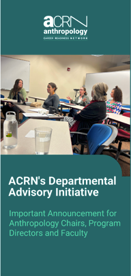
- Nimra Arooj produces brochures and flyers for dissemination, including an outstanding brochure on our Departmental Advisory Initiative (shown here).
- Emma Pramuk created a popular tool for professors from a student perspective: Promoting Courses with a Dash of Pop Culture. She’s continued to help with developing social media promos for our tools.
- Christian Castellanos has been helping to keep ACRN’s website updated by posting, ACRN Newsletters, Network-wide Meetings, World of Work blogposts (all bi-weekly), materials from client-based class projects, and other special projects.
- Bea Jackson has been conducting interviews to develop a new program for anthropology students within ACRN.
- Maryn Ascher is busy this summer updating our Anthropology Resources, a searchable database on articles, books, videos, and other media on anthropological practice.
- Alivia Archdale is renovating our Speaker’s Bureau by 1) reaching out to all existing speakers so that their profiles remain current, 2) inviting practitioners from some of the smaller subfields to consider becoming a speaker.
- Audrey Acres is our newest social media intern. Audrey is keeping ACRN’s news front and center on LinkedIn, Instagram, Bluesky, and other channels.
How does ACRN recruit interns?
We usually advertise opportunities in our Newsletter, at our Network-wide Meetings, and on our social media posts. We have also collaborated with Melissa Nelson, who manages University of North Texas anthropology internships for undergraduates. We are often approached by anthropology students hoping to do a remote internship.
Where are the benefits for the interns?
Mentoring is an important part of each internship, with ACRN leadership connecting interns with opportunities to grow their skills, expand their networks, and build careers they are excited about.
Here’s the impact of these internships in their own words:
- “I have some good news: I’ve received a verbal offer for a program-related position…Could I provide you as one of my references? Since we have volunteered together and you’ve been like a career mentor to me, I think you’d be able to speak to my skills and background.”
- “I just wanted to thank you all for helping me throughout the process of writing this blogpost. I’ve learned a lot, and I hope that my post can reach out to undergraduates considering field research.”
- “The resources of the ACRN were crucial for my graduate school applications, and the skills I learned as an ACRN intern helped me get a part-time job as a UX (user experience) and anthropology consultant while working on my master’s degree. Wherever I end up, the ACRN will have been, and will continue to be, a guiding light.”
- “I got offered the Marketing Associate position!! Bigggggg relief!”
What lessons has ACRN learned?
Interns offer fresh perspectives and creativity to our work at ACRN. We have learned much from our interns, as well as the internship process. Internships work best when both parties gain from the relationship, so we make an effort to make the internships meaningful. With many interns being current students or recent graduates, they also help us stay in touch with the training and perspectives of anthropology students and graduates. Simply put, interns make ACRN better. In return, they gain new skills, new networks, and career advice. Perhaps the most important lesson we have learned is that learning is a “two-way street.”
link back to table of contents
Committee Updates
Organizational Relations Committee (ORC) Reflections
NAPA Careers Expo
Our committee is continuing our work engaging with AAA to ensure this year’s Careers Expo is successful. Also check out our newest episodes from sNAPAshots Season 5! Next webisode drops on 7/1! If you’d like to participate in either effort, reach out and join us! Visit our contact portal and inquire today!
Niel Tashima & Joshua Liggett
Co-chairs, NAPA Organizational Relations Committee
link back to table of contents
Call for Volunteers
NAPA Communications – Social Media Mavens
Want to be at the center of the NAPA action? Want to know what we’re doing first and share that with the field? Become part of NAPA’s volunteer information communication hub and promote real world job opportunities and content across NAPA’s social media! Visit our contact portal and inquire today!
link back to table of contents
General Call for Volunteers and Publications
Interested in joining our team, but not sure which committee is right for you? Checkout our general volunteer application and one of our coordinators will connect you with the ones that best align with your interests and skill sets!
If you’d like to publish something with NAPA either in NAPA Notes, AnthroNews, or on our website or social media, visit our submission page and let us know.
link back to table of contents

![[NAPA Logo] sNAPAshots: Conversations with Professional, Practicing, and Applied Anthropologists. Kamela Heyward-Rotimi Executive Director Knowledge Exchange Research Group. PracticingAnthropology.org Bluesky, X, Meta, LinkedIn, and Youtube Logos](https://practicinganthropology.org/wp-content/uploads/Kamela-Heyward-Rotimi-Executive-Director-Knowledge-Exchange-Research-Group-768x960.png)
![[NAPA Logo] sNAPAshots: Conversations with Professional, Practicing, and Applied Anthropologists. Sheena McKinlay, Chief Impact Officer, Miracle Messages. PracticingAnthropology.org Bluesky, X, Meta, LinkedIn, and Youtube Logos](https://practicinganthropology.org/wp-content/uploads/Sheena-McKinlay-LinkedIn-Flyer-768x753.jpg)
![[NAPA Logo] sNAPAshots: Conversations with Professional, Practicing, and Applied Anthropologists. Matt Stoffer, Data Scientist. NextPoint Group. PracticingAnthropology.org Bluesky, X, Meta, LinkedIn, and Youtube Logos](https://practicinganthropology.org/wp-content/uploads/sNAPAshots-Matt-Stoffer-768x826.jpg)